Capacitor To Filter DC Signals
Many times in a circuit, both DC and AC signals need to be both be used in a circuit, at least at a certain stage of the circuit. However, at another stage, in the circuit, we may only want AC signals and the DC taken out.
How do we filter out the DC component of the signal?
We use a capacitor to filter out the DC signal.
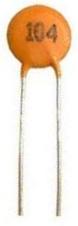
Usually, a 0.1µF ceramic capacitor is placed after the signal that contains both DC and AC
signals. And this capacitor filters out the DC component so that only AC goes through.
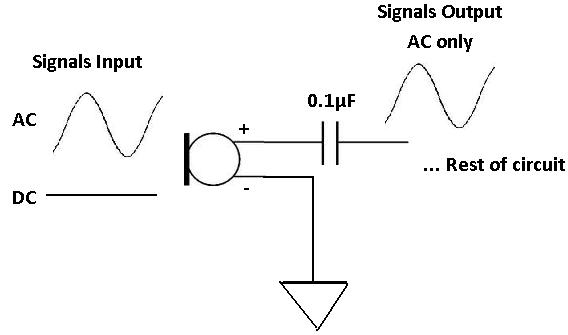
Input into the microphone are AC and DC signals. However, the DC signal is just used to provide power to the microphone and we do not want it to show up on the output. So we filter out the DC signal and we do this by using a 0.1µF capacitor. This capacitor blocks the DC signal so that we can just have our AC signal pass through, which is what we want. When we have a microphone circuit, we just want the AC signal (whether voice or music, whatever sound) to pass through.
A 0.1µF ceramic capacitor is usually used to filter out DC.