
Unijunction Transistor Characteristics Curve
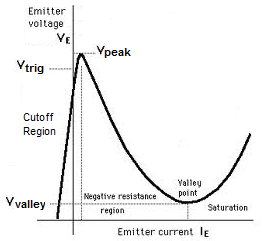
The above diagram is a Unijunction transistor characteristics curve.
Explanation of Characteristics Curve
Just because you see the characteristics curve doesn't mean you understand it.
We'll now explain what each section means so that you can better understand it.
Cutoff- This is the region where the unijunction transistor doesn't yet receive enough voltage to turn on.
The voltage hasn't yet reached the triggering voltage, so the transistor will not turn on.
Negative Resistance Region- After the transistor has reached the triggering voltage, VTRIG, it now will turn on. After
a while if the applied voltage still increases to the emitter lead, it will peak out at Vpeak. From Vpeak to the Valley Point, the applied
voltage drops while the current, though, increases. The current increases but the voltage decreases, which is
why it's called negative resistance.
Saturation- After the negative resistance region which saw an increase in current comes the saturation region.
This is the region
where if the applied voltage to the emitter still increases, the current and voltage will rise.